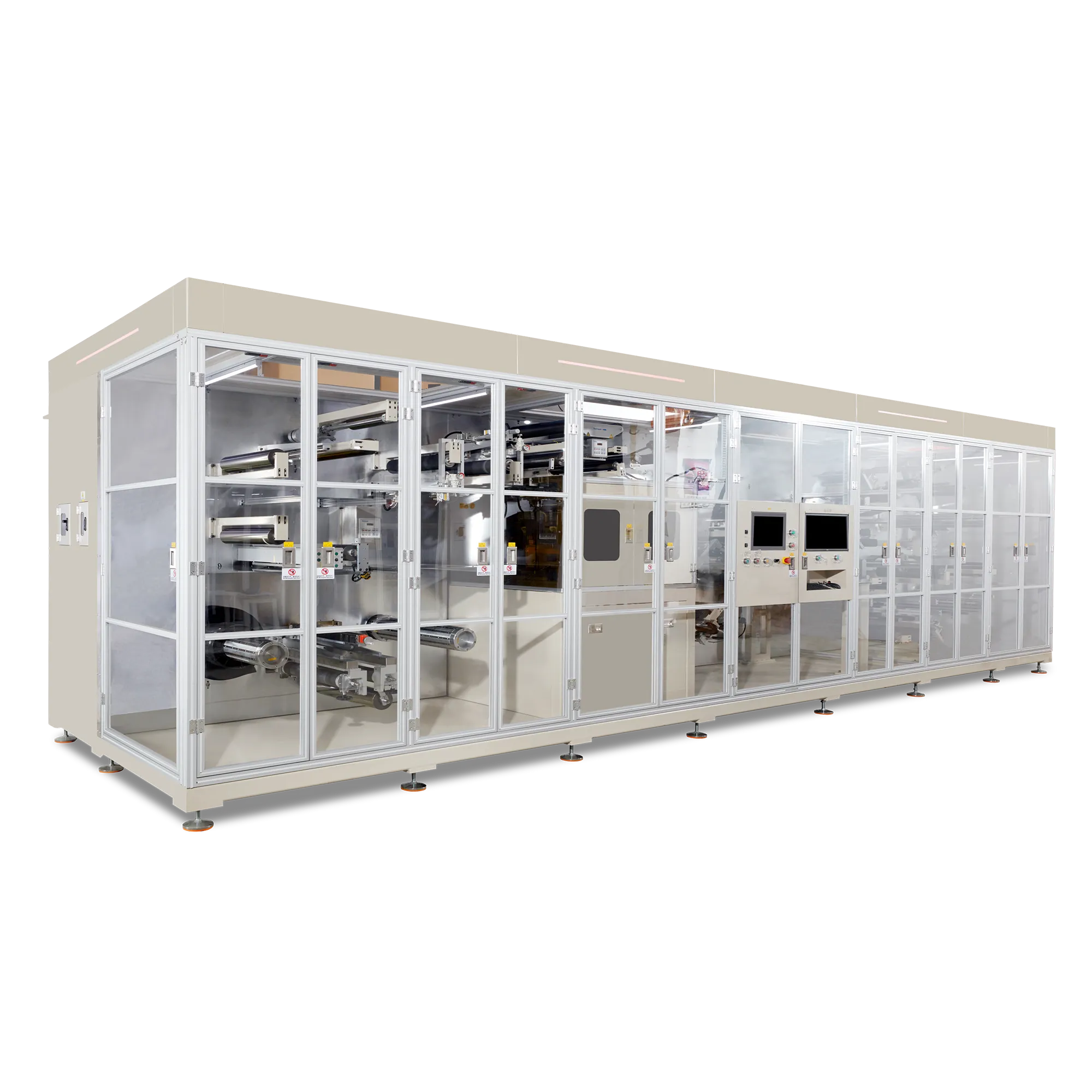
Functions
This Multi-tabs Electrode Die Cutting & Slitting Machine is specialized for multi-tabs forming and electrode slitting of coiled lithium ion electrode sheets (compatible with both pouch and prismatic battery electrodes). Its core functions include:
- Automatic unwinding of electrode coils
- Web deviation correction
- Multi-tabs laser cutting (equal / unequal spacing)
- Mark hole and positioning feature cutting
- Integrated electrode slitting
- Online dust and particle removal
- Automatic rewinding or electrode stacking
Technical Parameters
| Fiber optic laser pump source |
laser diodes |
| Fiber optic laser cutting power adjustable range |
10-100% |
| Fiber optic laser source service life |
100,000 hours |
| Processing speed |
120m/min |
| Heat affected zone (HAZ) width (laser-induced) |
≤0.1mm |
| Burr size |
≤10μm |
| Mark hole positioning accuracy |
±0.2mm |
| Electrode slitting accuracy |
±0.3mm |
| Electrode Winding deviation |
±0.5mm |
| Tension fluctuation |
±3N |
| First-pass yield (FPY) |
≥99.5% |
| Equipment utilization rate |
≥95% |
| Equipment noise level |
≤70db (1m outside the eqipment ) |
| Equipment dimension (reference) |
6000×2100×2700mm (LxWxH) |
| Applicable Electrode Specifications (exclusive to this laser cutting model): |
| – For pouch battery electrodes: |
|
| Coiled electrode width |
50mm – 200mm (supports flexible adjustment without mold replacement) |
| Electrode thickness |
0.03mm – 0.20mm (adapts to ultra-thin electrodes) |
| Double-sided tab quantity |
2-8 tabs (per side) |
| Minimum tab spacing |
3mm – 8mm (narrow-pitch tab design enabled) |
| – For prismatic battery electrodes: |
|
| Coiled electrode width |
70mm – 240mm |
| Electrode thickness |
0.05mm – 0.25mm |
| Double-sided tab quantity |
2-6 tabs (per side) |
| Tab shape |
Compatible with regular rectangular tabs + irregular special-shaped tabs |
Process Flow
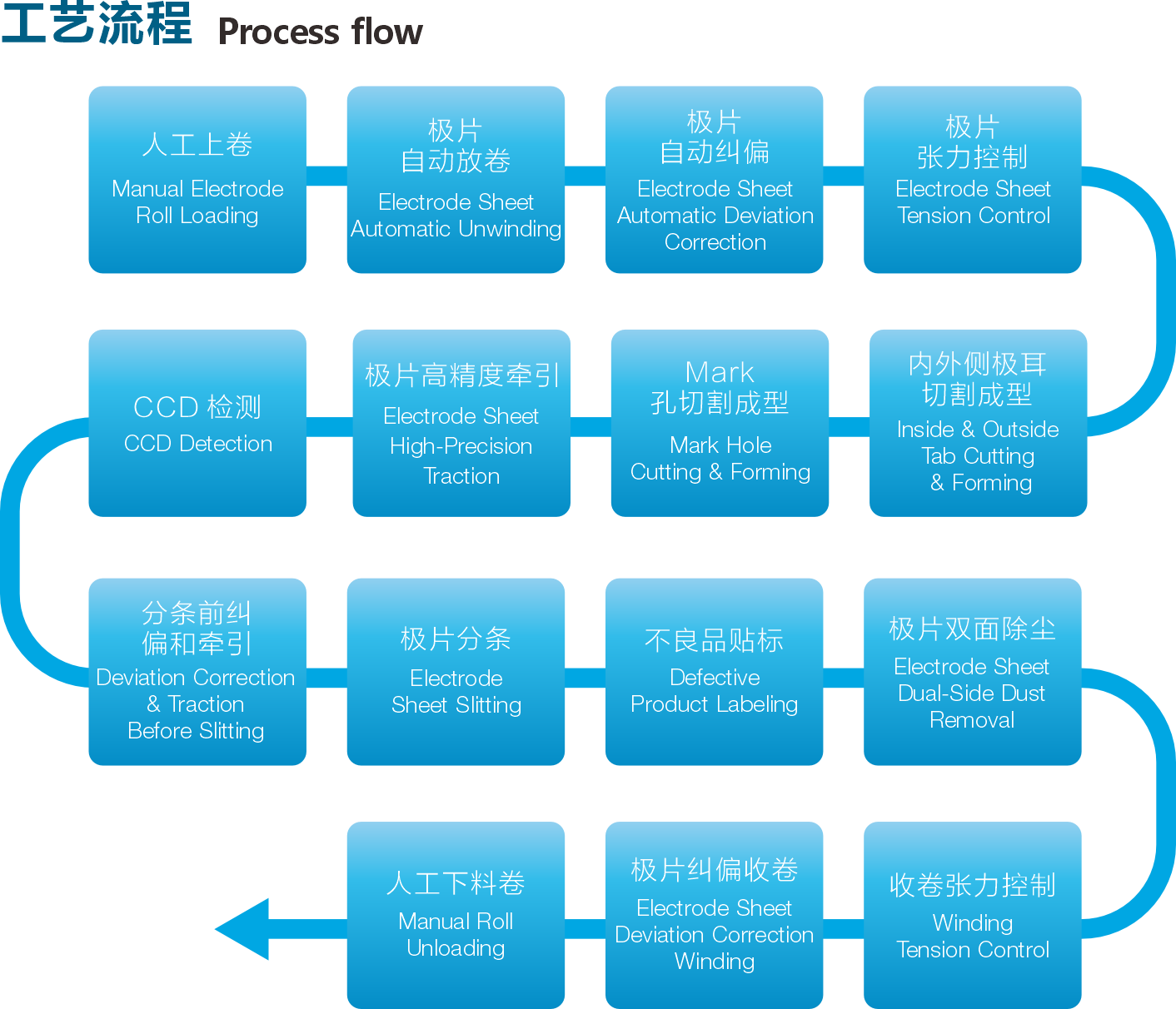
This section outlines where the Multi-tabs Laser Cutting & Slitting Machine is positioned within the electrode manufacturing workflow.
At this stage, coated electrode rolls are converted into multi-tabbed sheets and slit to defined widths for downstream cell assembly.
- Manual roll loading
- Automatic electrode unwinding
- Automatic electrode deviation correction
- Electrode tension control
- Inside & Outside Tab Cutting & Forming
- Mark Hole Cutting & Forming
- Electrode Sheet High-Precision Traction
- CCD Detection
- Deviation Correction & Traction Before Slitting
- Electrode Sheet Slitting
- Defective Product Labeling
- Electrode Sheet Dual-Side Dust Removal
- Winding Tension Control
- Electrode Sheet Deviation Correction Winding
- Manual Roll Unloading
Packing & Delivery
Packaging focuses on protecting laser optical modules, slitting units, and motion alignment references.
→view packaging standards
Innovation & Patents
This equipment is based on the patented
“Integrated Die-Cutting and Slitting Machine for Multi-Tab Electrode Processing.”
The design utilizes a synchronized dual-die structure to perform tab forming and width slitting within a single mechanical cycle, eliminating secondary alignment steps required in conventional processing.
This integrated approach removes sequential handling steps, reducing maintenance and improves positional consistency while sustaining the high-throughput production required for multi-tab electrode manufacturing.
→View Patent Certification
Certifications & Compliance
Certification scope and compliance documentation for this equipment are provided in the dedicated Certifications & Compliance section.
→View Certifications & Compliance
Process Advantage: Multi-tab Electrode Engineering
Multi-tab electrode architectures are increasingly used to reduce current density and improve thermal distribution in high-power pouch cells. However, they impose extremely strict requirements on tab geometry, edge quality, and positional accuracy.
This laser-based system eliminates mechanical stress and burr formation commonly seen in die-cutting, ensuring uniform tab dimensions and clean edges. The result is lower internal resistance, improved heat dissipation, and higher long-term cell stability in fast-charge and high-rate applications.