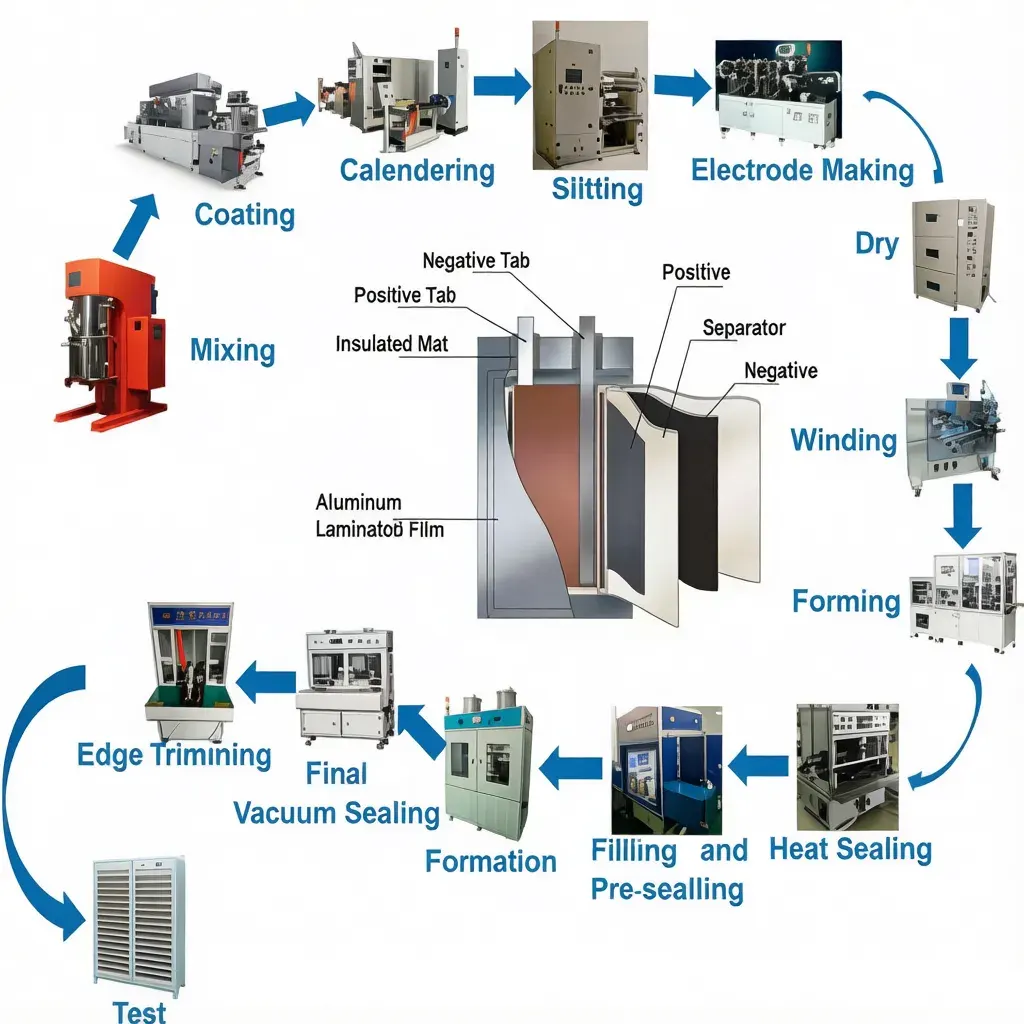
A Unified Set of Baseline Specifications Defining Performance Thresholds for Pouch Cell Pilot Line Equipment
Slitting accuracy: ±0.2–0.3 mm (material dependent)
Die-cut accuracy: ±0.2 mm
Stacking positional accuracy: ±0.1–0.2 mm
Winding tension control: ±0.5% of setpoint
Electrolyte filling accuracy: ±0.01 g (pilot configuration)
Vacuum degassing: <100 mbar (adjustable)
Throughput Range:
- R&D mode: <100 cells/hour
- Pilot mode: 1,000–2,000 cells/hour
(Scalable based on automation level and parallel stations)
Power: 220/380V, 50/60Hz
Control: PLC + HMI; MES/OPC/API interfaces optional
Environmental: Optional cleanroom compatibility (ISO Class 7–8)
Pneumatic and vacuum specifications customizable per site requirements
Complete specifications available upon request.
Application Scenarios
Pouch cell pilot lines support flexible, small- to medium-volume pouch cell production for R&D, validation, and early-stage scale-up.
Why this equipment is used
Pilot lines are used when cell design, materials, or processes are not yet finalized. Compared with mass-production assembly lines, pouch cell pilot lines enable controlled experimentation, validation of new chemistries and structures, and smoother transition from lab results to scalable manufacturing logic.
Core Application Scenarios
Battery R&D & Material Validation
Evaluation of new electrode structures, separators, electrolytes, and pouch formats under tightly controlled pilot conditions, supporting repeatable comparison across test batches.
→Related equipment:
Modular Pouch Cell Pilot Line for material and process validation
Consumer Electronics Prototyping
Prototype builds and small-batch production for smartphones, laptops, and wearables, validating assembly feasibility before committing to mass-production tooling.
→Related equipment:
Laser Cutting & Slitting Machine for pilot-scale pouch cell prototyping
Light Electric Mobility Development
Pilot manufacturing of pouch cells for e-scooters and light EVs, verifying performance consistency, process stability, and readiness for scale-up.
→Related equipment:
Automatic Electrolyte Filling Machine for EV pilot lines
Medical & Specialized Devices
Custom pouch cell development emphasizing sealing integrity, traceability, and documentation, suitable for regulated or safety-critical applications.
→Related equipment:
Automatic Vacuum Sealing Machine for pilot-scale medical pouch cells
Energy Storage & Portable Power
Prototype pouch cell production for ESS and portable power systems, focusing on cycle stability, safety margins, and process repeatability under extended testing.
→Related equipment:
Pilot-scale Pouch Cell Assembly Line for energy storage validation
Pilot Lines & Process Validation
- Pilot-to-Scale Readiness: Engineered for smooth transition from lab R&D to pilot production
- R&D-Focused Precision: Tight control over slitting, die-cutting, and vacuum degassing to validate process windows for new chemistries.
- Cell-Level Traceability: Full data capture from electrode input to final grading (MES/OPC compatible).
- Compact Modular Footprint: Optimized for lab/pilot floor spaces (30% smaller than standard lines), with plug-and-play modules for fast deployment.
- Low-Volume Efficiency: Adapts to <100 cells/hour (R&D) to 1,000–2,000 cells/hour (pilot) throughput, avoiding overcapacity waste in early-stage production.
Reliability & Data Integrity for Pilot Lines
- Designed for R&D and small-batch pilot reliability with consistent data and production stability:
- Pilot-Scale Process Repeatability: Maintains uniform slitting/die-cutting/stacking accuracy across multiple test batches, enabling reliable comparison of material/parameter performance.
- Cell-Level Traceability: Full data logging (barcode/QR integration) for fill weight, seal strength, and OCV/IR values — critical for R&D process optimization and quality auditing.
- R&D-Focused QA Documentation: Detailed process parameter logs, calibration records, and sample test reports to facilitate lab-to-pilot data handover and regulatory compliance.
- Quick Fault Recovery: Simplified fault diagnosis and rollback workflows tailored for frequent R&D adjustments, minimizing downtime during small-batch runs.
- Sensitive Material Protection: Gentle transfer modules and controlled environmental chambers (low humidity/inert gas) to preserve integrity of new or fragile electrode/electrolyte materials.
System Flexibility & Compatibility
- Engineered for flexible R&D and pilot production, seamlessly adapting to diverse workflows and systems:
- Cell Format: Compatible with R&D-focused pouch cells (small-format prototypes to 20Ah mid-scale cells) — optimized for flexible soft-package design validation.
- Production Modes: Supports dual-mode operation (standalone R&D for 0 cells/hour / inline pilot for 1,000–2,000 cells/hour) to match lab-to-pilot scaling needs.
- Line Integration: Plug-and-play compatibility with existing lab-scale electrode prep equipment and downstream R&D testing stations (OCV/IR grading, cycle-life testing).
- MES/ERP Compatibility: Cell-level traceability via barcode/QR integration, detailed process parameter logging (slitting speed, stacking pressure, filling precision), and compatibility with lab data management systems (LIMS).
- Material Flexibility: Adaptable to novel pouch laminates, custom tab geometries, and emerging electrolytes (Li-ion/Na-ion/semi-solid) — with no-code recipe adjustment for new material trials. downstream formation/testing stations — no need for new infrastructure investment.
Customization Capabilities & Options
Tailored to support new chemistry iteration and innovative pouch cell designs:
Tooling Customization: Custom dryer trays, mixer blades, coating dies, and calendering rollers supporting lithium/sodium-ion pouch/prismatic formats from R&D to pilot scale.
Process Equipment Options:
- Mixing & Drying Options: Adjustable speeds and vacuum levels for efficient slurry preparation, with heated drying zones for low-moisture output in liquid electrolyte systems.
- Coating & Calendering Adaptations: Variable coating speeds and calendering pressures for high-uniformity electrodes in pouch cell production lines.
- Stacking & Winding Options: Custom stack nests and winding cores for Z-folding or roll configurations, ensuring precision alignment in liquid cell assembly.
- Filling & Sealing Options: Micro-dosing pumps, vacuum degassing, and inert-gas purging for electrolyte filling — custom for pouch/prismatic liquid cell sealing.
Advanced Customization:
- Automation Upgrade: Modular robotics for small-batch handling across the full pilot line (dryer to testing).
- Control System Tailoring: Open PLC/HMI with custom data logging for R&D analytics on mixing, coating, etc.
- Environmental Adaptations: Low-humidity chambers for liquid electrolyte processing from drying to final assembly.
- Contact for custom pouch cell pilot line solutions.
R&D-Optimized Installation & Commissioning
Our engineering team, with proven track records from leading battery equipment companies, provides end-to-end pilot line commissioning. We cover the complete workflow from material preparation through final testing, ensuring each process step is optimized for your R&D objectives—whether you’re developing lithium-ion, sodium-ion, or next-generation battery chemistries in pouch or prismatic formats.
Process stages we optimize:
- Material preparation: dryer and slurry systems
- Electrode manufacturing: coating, calendering, slitting, and die-cutting
- Cell assembly: stacking/winding, electrolyte filling, and sealing
- Testing & validation: formation cycling and performance verification
Hands-On Training for R&D Teams
Specialized training developed for pilot-scale production and chemistry validation:
- Process parameter adjustment across all manufacturing stages
- Equipment maintenance and calibration procedures
- Small-batch production setup and optimization techniques
- Data collection protocols and analysis methods for R&D validation
Our training draws on extensive experience helping research teams transition from lab concepts to pilot production.
Warranty & R&D-Focused Support
- 12-month warrantycovering all R&D-critical equipment components across the complete pilot line
- Lifetime technical supportfrom engineers who understand both equipment and battery science
- 24/7 remote diagnosticsand process troubleshooting
- Flexible on-site supportfor process development challenges and material compatibility issues
Spare Parts & R&D Services
Complete parts coverage: All critical components across dryer, mixer, coater, calender, slitter, die-cutter, stacking/winding, filling, sealing, formation, and testing equipment
Advanced R&D support services:
Our advanced services are designed to accelerate your development cycle while incorporating crucial insights for seamless pilot-to-production scaling:
- New chemistry process window development and optimization
Material compatibility testing and comprehensive analysis reports
Pilot-to-mass-production scaling consultation - Process recipe optimization for novel cell designs and chemistries
- Knowledge transfer from our 700+ customers worldwide, including top-tier manufacturers like BYD, CATL, ATL, EVE and Apple’s battery suppliers, this unique knowledge transfer bridges pilot-scale development and mass-production readiness, providing proven pathways for industrialization and significantly de-risking your scale-up journey.
[→View complete after-sales service details ]
#compliance-pouch-pilot-line
Certifications & Compliance for Pouch Cell Pilot Lines
Compliance support for pouch cell pilot lines is structured around flexible, project-specific documentation rather than fixed mass-production certification packages. The focus is on supporting equipment delivery, validation, and regulatory readiness in R&D and small-batch environments where materials and process parameters may evolve.
Material Compatibility Validation (Delivery Scope)
At delivery, pilot line equipment is supported by structured validation covering:
- Aluminum-laminated films with different thickness, hardness, and sealing characteristics
- Separator materials, including ultra-thin, ceramic-coated, and reinforced types
- Electrodes with varying coating densities, tab geometries, and foil thicknesses
- Electrolytes with different viscosity and wetting behavior
Custom Process Window Documentation
Project-specific documentation may define validated operating ranges for:
- Heat-sealing temperature windows matched to selected films
- Compression and pressure ranges aligned with electrode structures
- Tension parameters for separator response control
- Electrolyte fill-weight tolerance ranges
Design Verification & Customized Module Support
For customized pilot configurations, delivery documentation may include:
- Design Verification (DV) records for custom fixtures and carriers
- Handling validation for fragile or non-standard electrodes
- Vision system alignment confirmation for project-specific geometries
Selective Compliance & Documentation Packages
To avoid unnecessary certification overhead, compliance support is provided based on deployment and audit needs:
- CE, UL, ISO 9001, RoHS (when required for market access or project approval)
- T/CPCIF 0090 electrolyte handling safety documentation (where applicable)
- UN 38.3 transport alignment for pilot-scale deployment
- Optional noise, vibration, or emissions reports
This compliance approach supports pilot line delivery, acceptance, and international deployment while preserving the experimental flexibility required in R&D-driven battery development.
→Explore pilot line engineering certification