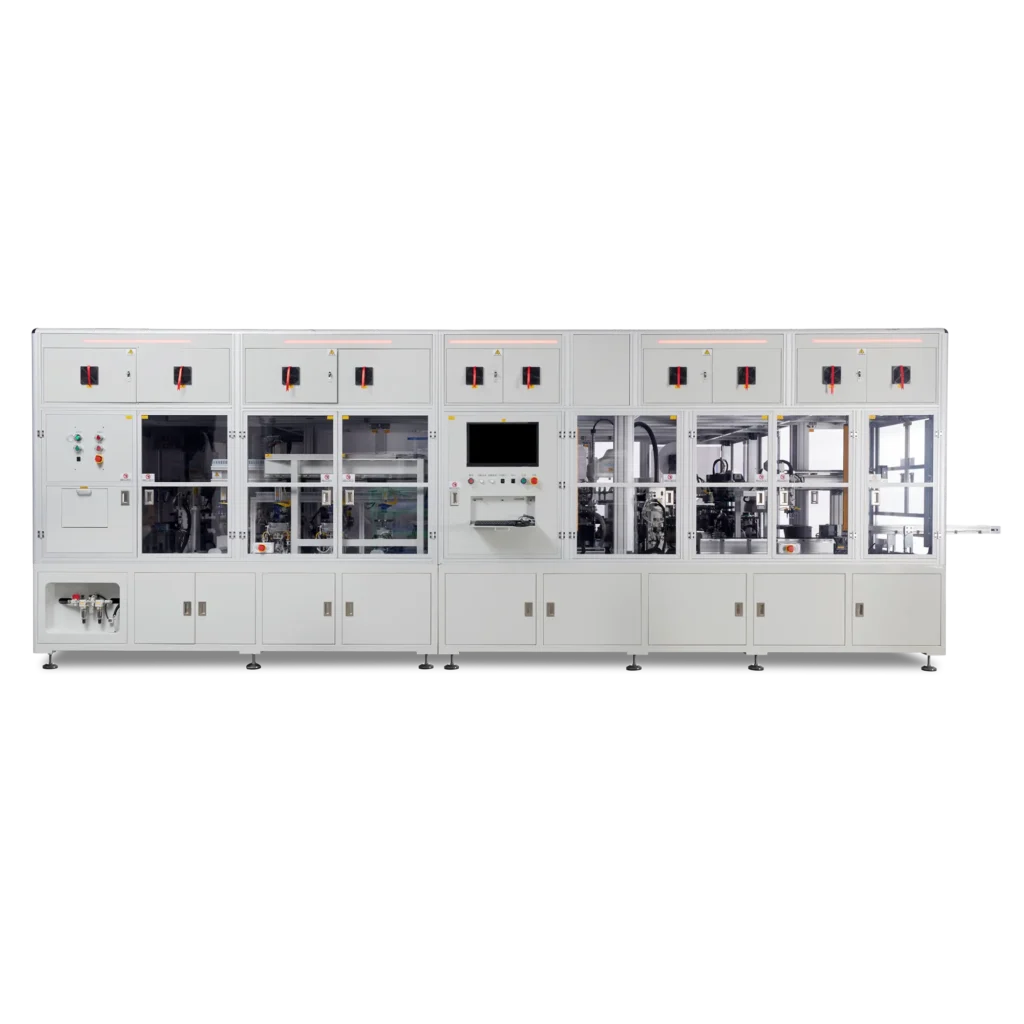
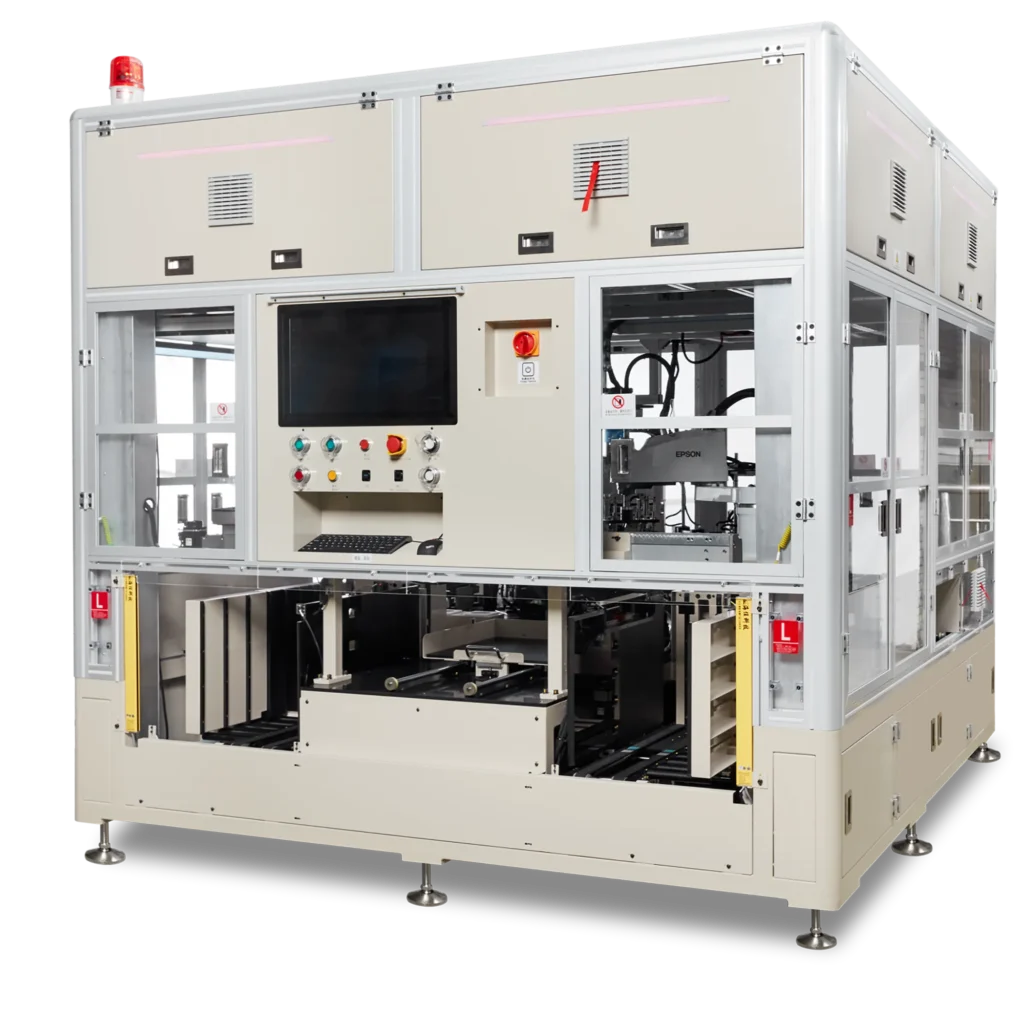
A Unified Set of Baseline Specifications Defining Performance Thresholds for All Battery Testing Equipment in This Category
Voltage Accuracy for OCV testing: ±0.0035% rdg + 0.0005% fs (model-dependent)
Internal Resistance Accuracy for OCV testing: ±(0.5% rdg. +0.1mΩ)
Test Speed: OCV testing: 15ppm; Sorting: 15ppm
Sorting Channels: 8 / 16 / 24 / 32 customizable
Supported Cell Types: Soft-pack (pouch), prismatic (square)
Communication: MES/ERP integration, barcode/QR traceability
Control System: PLC + industrial touchscreen, remote diagnostics
Application Scenarios
Battery testing equipment is deployed at the final quality-control stage of battery cell manufacturing, focusing on electrical consistency, traceable measurement, and reliable grading outcomes. It is typically positioned after formation, serving as the last verification step before downstream grouping or shipment.
Why this equipment is used
Unlike upstream processing or assembly equipment, battery testing systems are designed to validate results, not shape materials. Their role is to ensure that every finished cell meets defined electrical thresholds and can be confidently grouped for downstream applications.
This category emphasizes measurement accuracy, channel consistency, and data traceability, rather than mechanical processing speed or format flexibility.
Core Application Scenarios
Consumer Electronics Quality Control
Post-formation OCV and internal-resistance verification for smartphone, tablet, camera, and wearable cells, ensuring tight electrical distribution before pack assembly.
Typically deployed as the final gate before multi-cell grouping in compact battery packs.
Light Electric Mobility & Small EV Preparation
Electrical grading for scooter, e-bike, and light EV pouch or prismatic cells, where voltage and IR uniformity directly impact cycle life and thermal behavior.
Commonly integrated at the final electrical verification stage before cells enter module pairing.
Robotics & Automation Power Systems
Cell-level electrical screening for service robots, AGVs, and automation equipment requiring stable discharge behavior across long duty cycles.
Acts as a late-stage quality checkpoint to screen electrical outliers.
Industrial & Portable Equipment
Sorting and grading for handheld terminals, industrial instruments, and portable power devices, prioritizing traceable QA data over sheer throughput.
Often used in low- to medium-volume lines where electrical consistency outweighs speed.
Pilot Lines & Process Validation
Electrical performance benchmarking for R&D and pilot production, supporting process comparison across different batches, materials, or assembly routes.
Integrated with pilot or pre-production lines to provide repeatable, auditable test data for scale-up decisions.
Position in the Production Flow
Battery testing equipment typically operates:
- After formation and aging
- Before module pairing or shipment
- As the final electrical quality gate in both pilot and mass-production environments
- This positioning ensures that only electrically consistent cells proceed downstream, reducing module imbalance risk and improving overall system reliability.
- High-precision OCV/IR testing stability
- A low-noise measurement architecture ensures ultra-stable OCV/IR sampling with repeatable, lab-grade accuracy—crucial for evaluating pouch and prismatic cells in R&D and pilot production.
- Multi-criteria, customizable cell grading
- Supports advanced sorting rules based on voltage, IR, capacity reference curves, or user-defined parameters, enabling flexible QA strategies across different battery programs.
- High-throughput parallel testing & automated sorting
- Multi-channel synchronous sampling combined with automated binning modules accelerates cycle time and maximizes pilot-line productivity.
- Fully traceable QA workflow with MES readiness
- Barcode/QR code binding and structured data logging create a closed-loop traceability path from incoming inspection to outbound QA—supporting global factory digitalization requirements.
- Adaptable to a wide range of cell dimensions
- Quick-adjust fixtures and modular receiving bins allow seamless handling of multiple pouch and prismatic formats, reducing changeover time for multi-SKU lines.
- Enhanced stability for diverse materials and designs
- Electrical measurement algorithms compensate for variations in electrode density, foil thickness, and tab geometry, ensuring consistent readings across different suppliers and cell generations.
- Our battery testing systems deliver high-precision, repeatable results tailored for pouch and prismatic cell QC, pilot lines, and R&D labs.
- Micro-ohm–level IR/OCV accuracy and stable long-term drift suppression ensure consistent grading across batches.
- Multi-channel simultaneous testing & automated sorting support high-throughput pilot-scale production and quick sample throughput.
- Built-in self-diagnostics and protection systems guard against voltage spikes, polarity errors, and contact instability — critical for long-duration test campaigns.
- Full data traceability & export-ready QA logs enable integration with MES/LIMS systems and support international audit compliance.
- Adaptable clamping and tray systems for varying thicknesses and tab orientations
- Optional non-contact transfer modules for sensitive soft-package cells
Production Modes
- Inline mode:Seamless integration with upstream formation lines and downstream aging/grouping sections.
- Standalone mode:Independent testing islands for R&D or small-batch production.
- Mixed-flow support:Flexible scheduling and recipe switching for different capacity grades or product SKUs.
Data & System Integration
- Real-time communication with MES/ERP
- Test-record traceability for cell-level monitoring
- Open protocol interfaces for multi-vendor production environments
- Custom sorting bins (number, size, levels)
- Adjustable OCV/IR test ranges
- Fixture customization for oversized or ultra-thin pouch cells
- Optional MES, data-export, and API integration
- Custom software for multi-parameter grading rules
Installation & Commissioning
Professional setup and validation for OCV/IR testing and battery sorting systems, managed by our experienced engineering team:
- Precision calibration of all measurement channels
- Fixture configuration for various pouch and prismatic cell formats
- MES system integration for complete test-record traceability
- Multi-channel sorting synchronization and validation
We perform comprehensive accuracy verification against international metrology standards before equipment handover, ensuring measurement reliability from day one.
Operator Training & Maintenance
Focused training programs covering testing equipment operation and maintenance:
- OCV/IR sensor calibration procedures and best practices
- Contact probe maintenance and replacement schedules
- Sorting mechanism operation and troubleshooting
- Measurement accuracy monitoring and quality control methods
- Statistical process control (SPC) implementation for production environments
Training is delivered by engineers with practical experience in battery testing operations at leading manufacturers.
Warranty & Rapid Technical Support
- 12-month warrantyon all core measurement modules including voltage/IR detection units, PLC controllers, and touchscreen terminals
- Lifetime technical supportfrom our experienced team
- 24/7 online diagnosticsfor immediate troubleshooting
- Fast on-site servicewhen remote support cannot resolve critical issues
Spare Parts & Metrology Services
Stocked critical components: Precision measurement probes, sorting actuators, fixture clamping systems, control modules
Professional services:
- Periodic accuracy re-verification traceable to international metrology standards
- Test data analysis optimization for improved grading consistency
- Statistical process control setup and implementation support
- Custom sorting algorithm development based on your specific quality requirements
[→View complete after-sales service details ]
#compliance-battery-testing
Certifications & Compliance for Battery Testing Equipment
Compliance support for battery testing equipment focuses on measurement traceability, calibration integrity, and data reliability rather than manufacturing process compliance. These systems function as electrical measurement and quality verification tools, supporting grading, sorting, and audit readiness at the final stage of battery cell production.
Measurement Traceability & Calibration Documentation
Project-level compliance support may include:
- Calibration records traceable to national metrology institutes (e.g. NIST, PTB, NIM)
- Documented accuracy verification for OCV, IR, and related electrical parameters
- Long-term measurement stability records where required
- Periodic re-verification protocols aligned with customer quality systems
Channel Consistency & Data Integrity Validation
To support reliable grading and sorting, documentation may cover:
- Multi-channel consistency analysis for high-throughput testing systems
- Channel-to-channel deviation records and acceptance thresholds
- Electrical safety validation specific to measurement circuits and test fixtures
- Verification of measurement repeatability and drift control
Data Management & Audit Readiness
Compliance support may also include:
- Documented data mapping for MES or factory quality systems
- Traceability of test results to cell IDs and batch records
- Data integrity support for internal audits, customer reviews, or regulatory inspections
Standards Alignment (Project-Dependent)
Where applicable, testing systems may align with:
- Relevant battery performance testing standards (e.g. ISO 12405, project-dependent)
- Region-specific electrical safety and equipment requirements when required
- This measurement-focused compliance framework ensures testing equipment delivers reliable, traceable, and auditable electrical data—supporting quality control decisions without being conflated with manufacturing process equipment.
→Review measurementcompliance standards