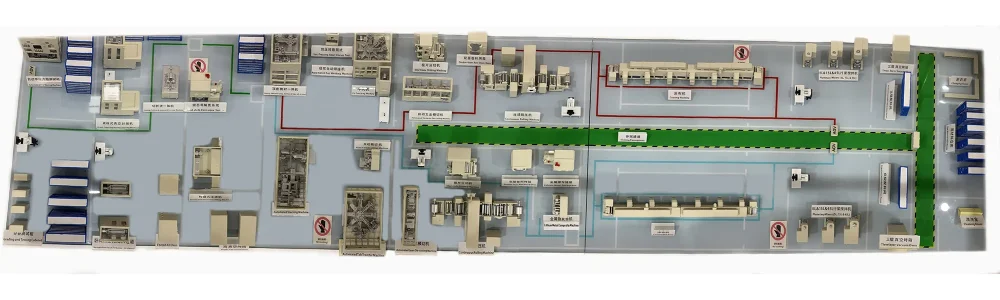
Included Equipment & Core Processes (High-Level Scope)
This solid-state pilot line supports complete R&D-to-pilot workflows for polymer, sulfide, and oxide electrolyte systems. It provides two complete assembly routes — stacking and winding — and allows rapid adjustments for wet, semi-dry, and dry processing.
Core Equipment Groups (High-Level Abstract Structure)
A. Electrode & Electrolyte Preparation
- Mixing systems for active materials, polymer gels, and composite slurries
- Coating machines for polymer electrolytes or solid-electrolyte precursor layers
- Calendering machine (optional depending on system chemistry)
- Granulation system
- For dry-process solid electrolyte particle conditioning & size control
- Multi-stage rolling system
- For solid-electrolyte sheet formation & densification
B. Composite Layer Formation for Sulfide / Oxide Systems
Composite Laminating Machine
- For electrolyte–electrode composite film construction
- Used for wet-transfer routes and multi-layer SSB structures
Isostatic Press
- For uniform densification of sulfide/oxide electrolyte sheets
- Enhances interfacial contact and mechanical stability
C. Electrode Shaping & Cell Assembly
- Die Cutting Machine (for electrode and electrolyte shaping)
- Stacking or Winding Machine (dual-route compatibility)
- Hot-press system (polymer electrolyte activation & interlayer bonding)
- Low-moisture primary sealing system
- Filling machine for semi-solid systems (if applicable)
- Vacuum sealing & final pouch sealing
D. Pilot Verification & Electrical Evaluation
Formation systems tailored to solid-state interfaces
Capacity grading & performance verification modules
This architecture ensures a unified but highly flexible pilot line capable of adapting to:
- Polymer wet processes
- Sulfide wet-transfer processes
- Oxide wet-transfer processes
- Emerging dry solid electrolyte shaping routes
- Compatible electrolyte systems: Polymer (primary), Sulfide, Oxide
- Typical pilot cell capacity: 5–20Ah pouch format
- Environmental control:
- Low-moisture chambers for electrolyte handling
- Optional sub-dew-point rooms for sulfide processes
Process precision:
- Coating uniformity optimized for solid electrolyte films
- Multi-stage rolling precision for dry-processed electrolyte sheet thickness
- Modular configuration enabling stacking or winding
- High-temperature, low-temperature, and pressure-assisted interfaces supported
Application Scenarios
Solid-state battery pilot lines are designed for advanced battery R&D environments, focusing on solid electrolyte processing, interface control, and low-volume validation of next-generation cell architectures. This category supports polymer-based solid-state batteries as well as lab-scale validation for oxide and sulfide systems.
Why this equipment is used
Unlike conventional pouch cell pilot lines, solid-state battery pilot lines prioritize material compatibility, interface stability, and pressure-sensitive assembly control rather than throughput. They are built for laboratories and innovation centers where new solid electrolytes, composite structures, and dry or semi-dry processes must be validated before industrialization.
Core Application Scenarios
- Solid Electrolyte Material Evaluation
Processing trials for polymer, oxide, and sulfide solid electrolytes under controlled environments. - Next-Generation Cell Architecture Development
Validation of laminated, composite, and dry-sheet solid-state cell structures, focusing on layer uniformity, pressure response, and stack integrity. - Interface & Process Optimization
Evaluation of electrode–electrolyte interfaces, hot-pressing behavior, and pressure-dependent assembly steps critical to solid-state battery performance and cycle stability. - Low-Volume Demonstration Lines
Small-batch demonstration production of solid-state cells to verify manufacturability, process repeatability, and scale-up feasibility prior to industrial deployment. - One line for three systems: polymer, sulfide, oxide (wet/semi-dry/dry)
- Route-switching modularity: stacking ↔ winding, wet ↔ dry
- Supports composite electrolyte innovation via lamination & isostatic densification
- Dry-process-ready with granulation + multi-stage rolling integration
- Customizable environmental control for moisture-sensitive materials
- R&D-to-Pilot seamless scaling (lab → 5Ah → 10Ah → 20Ah)
- High compatibility with mainstream SSB chemistries
- Process repeatability designed for multi-chemistry verification
- Stable interlayer bonding through controlled hot-pressing
- Uniform electrolyte densification using multi-stage rolling or isostatic pressing
- Long-term reliability through controlled sealing & formation regimes
- Pilot-scale QA packages for solid electrolyte uniformity and interface integrity
- Compatible with polymer wet-process pilot lines
- Adaptable for sulfide/oxide wet-transfer workflows
- Ready for emerging dry solid-electrolyte manufacturing
- Dual-mode assembly: stacking or winding
- Supports hybrid semi-solid processes
- Open integration for external material-preparation modules (gel, composite sheets, nano-powders)
- Custom composite structures (electrolyte–electrode architectures)
- Adjustable pressure ranges for hot-pressing & isostatic pressing
- Tailored rolling thickness profiles for dry electrolyte sheets
- Custom environment control (low-temp, sub-dew, inert atmosphere)
- Modular station expansion for new SSB material systems
- Data interfaces for lab informatics & R&D tracking
After-Sales Engineering Support for Solid-State Battery Pilot Lines
Solid-state battery pilot lines require a fundamentally different after-sales support model compared to conventional liquid-electrolyte battery equipment. Our service framework is engineered specifically for all-solid-state and semi-solid battery pilot systems, where material behavior, interface stability, and process windows evolve continuously during development.
Rather than focusing on fixed mass-production benchmarks, our after-sales services are designed to support process exploration, parameter iteration, and pilot-scale validation across polymer-based, oxide-based, and sulfide-based solid-state battery technologies.
Installation & Pilot Commissioning
Installation and pilot commissioning are conducted at the process-system level, ensuring the entire solid-state battery pilot line is ready for controlled experimentation, material evaluation, and iterative process development.
Commissioning focuses on:
- Process route alignment
Validation of the intended solid-state process flow, including solid electrolyte preparation (mixing, synthesis, or precursor handling), electrode and electrolyte layer formation routes, interface consolidation logic, and pilot-defined cell enclosure strategies. - Parameter window verification
Verification of critical process windows affecting solid-state systems, such as material homogeneity, layer thickness stability, interface pressure or temperature conditions, and atmosphere control requirements (dry-room or inert environment). - Cross-process coupling validation
Assessment of interactions between material preparation, layer formation, and cell-forming steps to ensure repeatable behavior at pilot scale, rather than fixed mass-production targets. - Pilot reproducibility confirmation
Initial trial runs focused on process repeatability, adjustability, and data reliability—supporting iterative R&D cycles for polymer-based, oxide, sulfide, or semi-solid battery systems. - Commissioning outcomes emphasize process controllability and scalability insight, forming a reliable foundation to bridge the gap between lab-scale concepts and pilot-scale validation.
Operator Training & Technical Guidance
(For Solid-State R&D & Pilot Teams)
Training and technical guidance are designed specifically for solid-state battery R&D engineers, pilot-line operators, and process developers, emphasizing understanding of material behavior and process interactions rather than routine equipment operation.
Training scope includes:
- Solid-state process logic understanding
Interpretation of how material properties, layer formation conditions, and interface treatments influence cell-level performance, stability, and yield at pilot scale. - Parameter adjustment methodology
Guidance on adjusting process parameters in response to material changes, formulation updates, or experimental objectives—supporting rapid iteration without compromising pilot consistency. - Environment and contamination control awareness
Best practices for managing moisture sensitivity, atmosphere control, and cross-contamination risks inherent to solid-state and semi-solid battery development. - Pilot troubleshooting frameworks
Structured approaches to diagnosing process instability, material inconsistency, or interface-related issues, based on process data rather than equipment fault assumptions. - Training emphasizes process cognition and decision-making, enabling teams to independently refine solid-state battery pilot workflows as materials and cell architectures evolve.
Warranty & Technical Support
To support long-term pilot programs and iterative development cycles:
- 12-month warranty covering complete solid-state pilot line equipment
- Lifetime technical support for ongoing process optimization and system adaptation
- 24/7 remote diagnostics with engineers experienced in solid-state battery challenges
- Rapid on-site response for system reconfiguration, process debugging, or equipment tuning
- Our support is strategically aligned with your key R&D milestones—from initial lab discovery to pilot validation—ensuring critical assistance when you need it most.
Customized On-Site Engineering Packages
For advanced development programs, customized on-site support packages are available:
- First pilot batch stabilization and repeatability support
- Tooling and fixture adjustment for novel solid electrolyte materials
- Format-change support for pouch-type solid-state battery architectures
- Mechanical interface optimization for stacking, lamination, and sealing consistency
- These services are delivered by engineers with hands-on experience in ASSB pilot equipment and next-generation battery pilot systems.
Long-Term Pilot-Line Support
Our service model has been applied across collaborations with solid-state battery research institutes, university laboratories, and early-stage industrial developers, supporting pilot-scale ASSB production lines for polymer, oxide, and sulfide systems.
This ensures your solid-state battery pilot equipment remains a stable, adaptable, and technically reliable platform throughout material validation, process development, and scale-up preparation.
Our after-sales service is not an add-on—it is an extension of the solid-state battery engineering process itself, supporting reliable experimentation and informed scale-up decisions.
#compliance-solid-state
Certifications & Compliance for Solid-State Battery Pilot Lines
Compliance support for solid-state battery pilot lines is designed for R&D and pilot-scale environments, focusing on material safety, controlled processing conditions, and documented validation rather than mass-production certification. The objective is to support safe equipment delivery, experimental verification, and regulatory readiness during early-stage solid-state battery development.
Material Safety & Chemistry-Specific Validation
At delivery, compliance support may include safety validation and documentation for:
Polymer, sulfide, and oxide solid electrolyte systems
- Moisture-sensitive and air-sensitive material handling protocols
- Ceramic and composite material contact compatibility
- Safety measures for specialized powders, films, and laminates
Controlled Environment & Process Route Documentation
Project-level documentation may cover:
- Low-moisture or inert atmosphere environment validation (where required)
- Process route documentation for wet-transfer, laminated composite, and dry-sheet workflows
- Safety-related operating boundaries for pressure, temperature, and atmosphere control
Standards Alignment (Project-Dependent)
Where applicable, documentation may reference:
- IEC 63115-1 terminology and safety considerations for solid electrolyte batteries
- GB/T 38031 thermal stability and protection criteria (project-dependent)
- CE / UL / ISO / RoHS alignment when required for equipment deployment or audits
Experimental Process Documentation & Third-Party Support
To support iterative development, compliance support may include:
- Process window documentation for experimental iterations
- Interface bonding and layer density validation records (when required)
- Optional third-party laboratory collaboration for material or interface analysis
- Equipment modification and upgrade documentation supporting process evolution
- This compliance framework supports safe operation and documented validation for solid-state battery R&D while intentionally avoiding over-certification that could restrict experimental flexibility.
→Discover solid-state compliance approach