
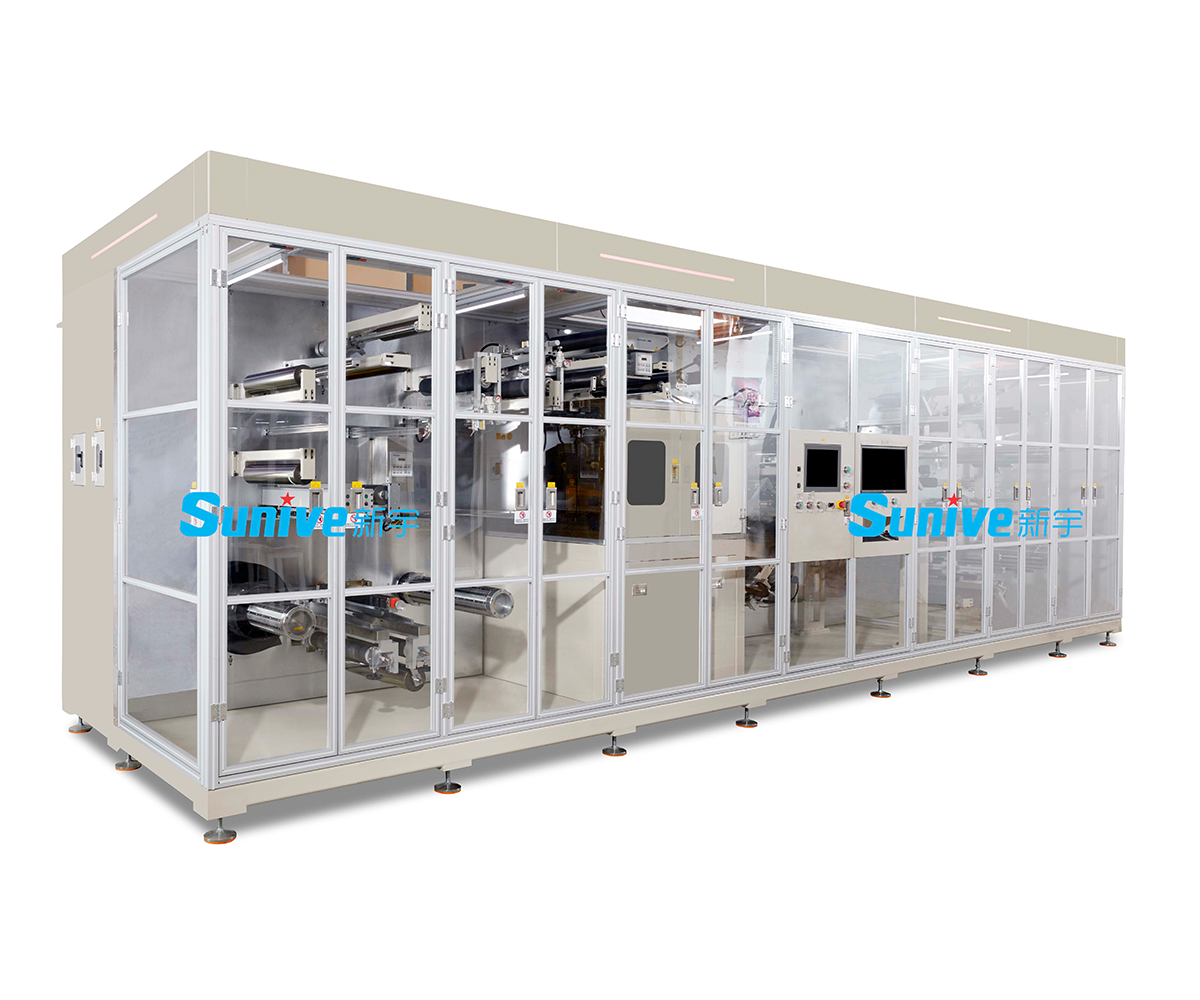
Use Cases
Forms multi-tab electrode patterns through mechanical die-cutting while slitting the continuous web to production width in high-volume manufacturing.
Why this machine: For high-volume production with stable designs, laser systems can be over-specified. Die-cutting offers superior throughput and lower cost-per-cell while maintaining high repeatability.
Ideal User: High-volume manufacturers with mature, standardized tab designs (e.g., Power banks, standard smartphones).
When to choose: When cost-sensitivity and maximum throughput are the primary goals and the coating type does not require laser processing.
Related Equipment: Multi-tabs laser cutting & slitting machine for battery cells · Single-piece die-cutting machine
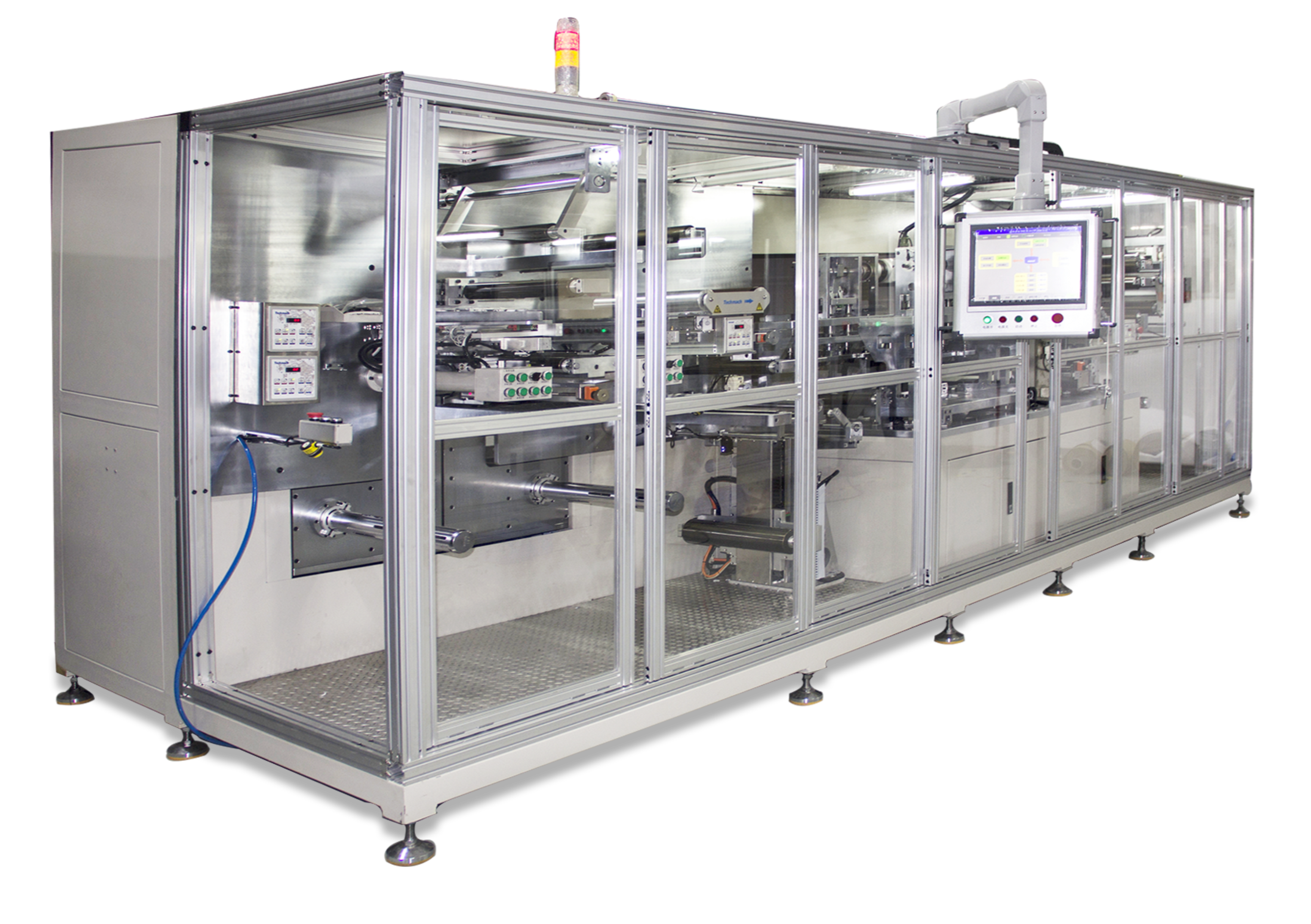
Equipment Features
These features maintain mechanical die-forming stability during high-speed tabbing and slitting operations.
Dedicated mechanical structure for multi-tabs electrode forming
Integrated die-cutting and slitting architecture
Servo-driven tension control to prevent tab deformation
Multi-stage rectification for long-run stability
Dual-side tab forming capability
Targeted dust collection at cutting and slitting zones
Core Advantages: Die-Cutting vs. Laser Cutting
Die-Cutting (Hardware)
Mechanical Stability & Cost Efficiency: Ideal for standardized electrode designs with limited format variation, offering a mechanically stable and cost-effective solution.
Low Operational Variability: For long production runs, stable tab geometries, and a small number of electrode models, it eliminates frequent parameter tuning and format revalidation. Once tooling is finalized, production changeover time and operational variability are significantly reduced.
Predictable Costs: Requires lower initial equipment investment and delivers predictable operating costs when model diversity is limited.
Best For: Mature consumer electronics, light EV, and small energy storage applications where process stability, throughput consistency, and controlled manufacturing costs are primary objectives.
--------------------------------------------------------------------
Laser Cutting
Material Integrity: Enables non-contact electrode processing, eliminating mechanical stress on thick or high-loading coatings. This is critical in EV and ESS electrode development, as preserving coating integrity directly impacts achievable energy density and cycle stability.
Design Flexibility: Removes mold dependency, allowing faster design iteration and format changes during R&D and pilot stages.
Future-Proofing: For manufacturers validating new chemistries or scaling large-format electrodes, it offers a future-proof path that balances precision, flexibility, and material utilization efficiency.
Best For: R&D, evolving designs, and high-flexibility applications requiring uncompromised material integrity.
- Information -
- Product recommendation -
 Automatic Vacuum Sealing Machine for EV Battery Cells
 Automatic Vacuum Sealing Machine for Consumer Electronics Battery Cells
 Automatic Vacuum Sealing Machine for Bluetooth Device Battery Cells
 Automatic Electrolyte Filling Machine for EV Battery Cells
 Automatic Electrolyte Filling Machine for Consumer Electronics Battery Cells
 Automatic Electrolyte Filling Machine for Bluetooth Device Battery Cells
 Solid State Batteries Pilot Line
Get a free quote
Need to chat?
Address: Building 3, No. 10, Yanhexi 1st Road, Dongkeng Town, Dongguan City, Guangdong Province
Tel: +86-180 3829 6209
Email: marketing@sunive.cn